**Why this matters for aviation training**
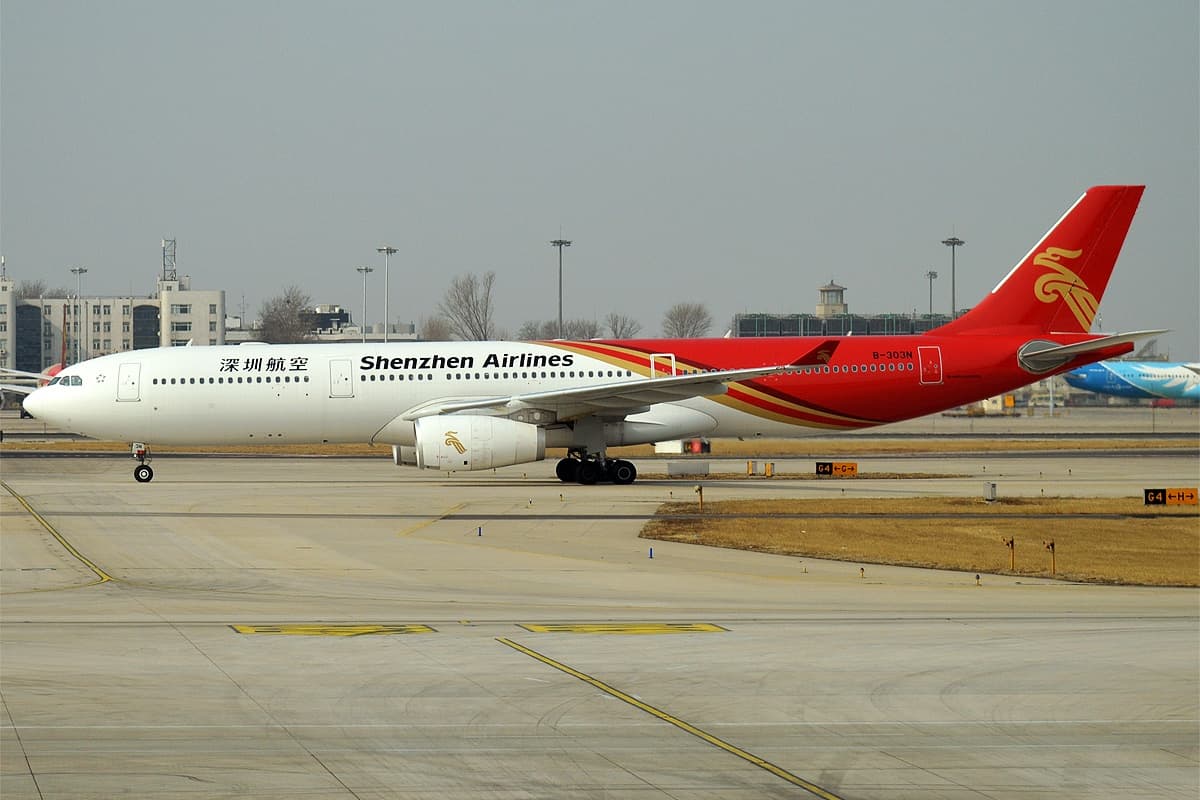
China’s Civil Aviation Administration (CAAC) is consulting on a regulatory change that could reshape the country’s long-haul network. Since March 2025, a rule gave priority to Shanghai, Beijing, and Guangzhou for flights to Europe and North America, concentrating traffic on those three hubs. Now, Shenzhen Bao’an Airport (ZGSZ) is being positioned as a fourth major gateway, with airlines based there allowed to add more intercontinental routes, including transpacific services.
For ATPL and ATC students, this is not just a policy shift — it is a live case study in how regulation drives route development, capacity allocation, and airspace demand. Understanding the CAAC’s hub strategy helps future pilots and controllers anticipate where new routes will appear, how traffic flows will change, and what that means for airport slot coordination and air traffic management.
**Shenzhen’s expansion plans**
Shenzhen Bao’an is already one of China’s busiest airports, handling 66.49 million passengers in 2025 — putting it in the same league as Shanghai Pudong, Guangzhou Baiyun, and Beijing Capital. The airport currently has three runways, two terminals, and a satellite pier. A new Terminal 2 (T2) covering 400,000 m² is under construction, designed for 31 million additional passengers per year as part of the 15th Five-Year Plan (2026–2030). Long-term plans aim for a capacity of 98 million passengers and 5 million tonnes of cargo annually.
This expansion is happening alongside the CAAC’s new civil aviation law, which came into force on 1 July 2026, and a broader overhaul of traffic rights and hub policies. For ATC trainees, the growth of Shenzhen means more complex airspace coordination with nearby Hong Kong International Airport (HKIA), which handled 61 million passengers in 2025 and remains the world’s top cargo airport with over 5 million tonnes of freight.
**A new competitive dynamic in the Greater Bay Area**
The Greater Bay Area airport cluster — including Baiyun, Bao’an, and Hong Kong — processed over 168 million passengers in 2025. Shenzhen’s rise as a long-haul hub directly challenges Hong Kong’s traditional role as the region’s international gateway. The CAAC document explicitly invites Shenzhen to strengthen connections with global innovation and financial centres such as San Francisco, Boston, New York, London, Singapore, and Sydney, as well as key nodes along the Belt and Road Initiative.
For ATPL students, this means more long-haul routes to study, more diverse flight planning scenarios, and a deeper understanding of how geopolitical and economic factors influence airline network strategies. For ATC students, it means preparing for increased traffic density, new route structures, and the need for seamless coordination between adjacent FIRs.
**What this means for your training**
Whether you are studying for your ATPL or training as an air traffic controller, this news illustrates how regulatory decisions create real-world operational changes. The CAAC’s shift is a reminder that aviation is never static — new hubs emerge, traffic rights evolve, and infrastructure expands. Keeping an eye on such developments will help you stay ahead of the curve in your career.