Airbus has started 2026 with a mixed first quarter: commercial aircraft deliveries declined, impacting revenue and operating profit, while orders and defense activity remained strong. The group maintains its annual targets, supported by a record backlog of over 9,000 aircraft and the planned ramp-up of assembly lines.
Between January and March 2026, Airbus delivered 114 commercial aircraft, compared to 136 a year earlier. This decrease led to a 7% drop in group revenue to €12.7 billion, and a 52% fall in adjusted EBIT to €300 million, down from €624 million in Q1 2025. Net income reached €586 million, boosted by financial results, though lower than the €793 million recorded a year ago. The commercial aircraft division saw revenues decline 11% to €8.4 billion, mainly due to lower delivery volumes and unfavorable dollar effects. Of the 114 deliveries, Airbus handed over 19 A220s, 81 A320 family aircraft, 3 A330s, and 11 A350s.
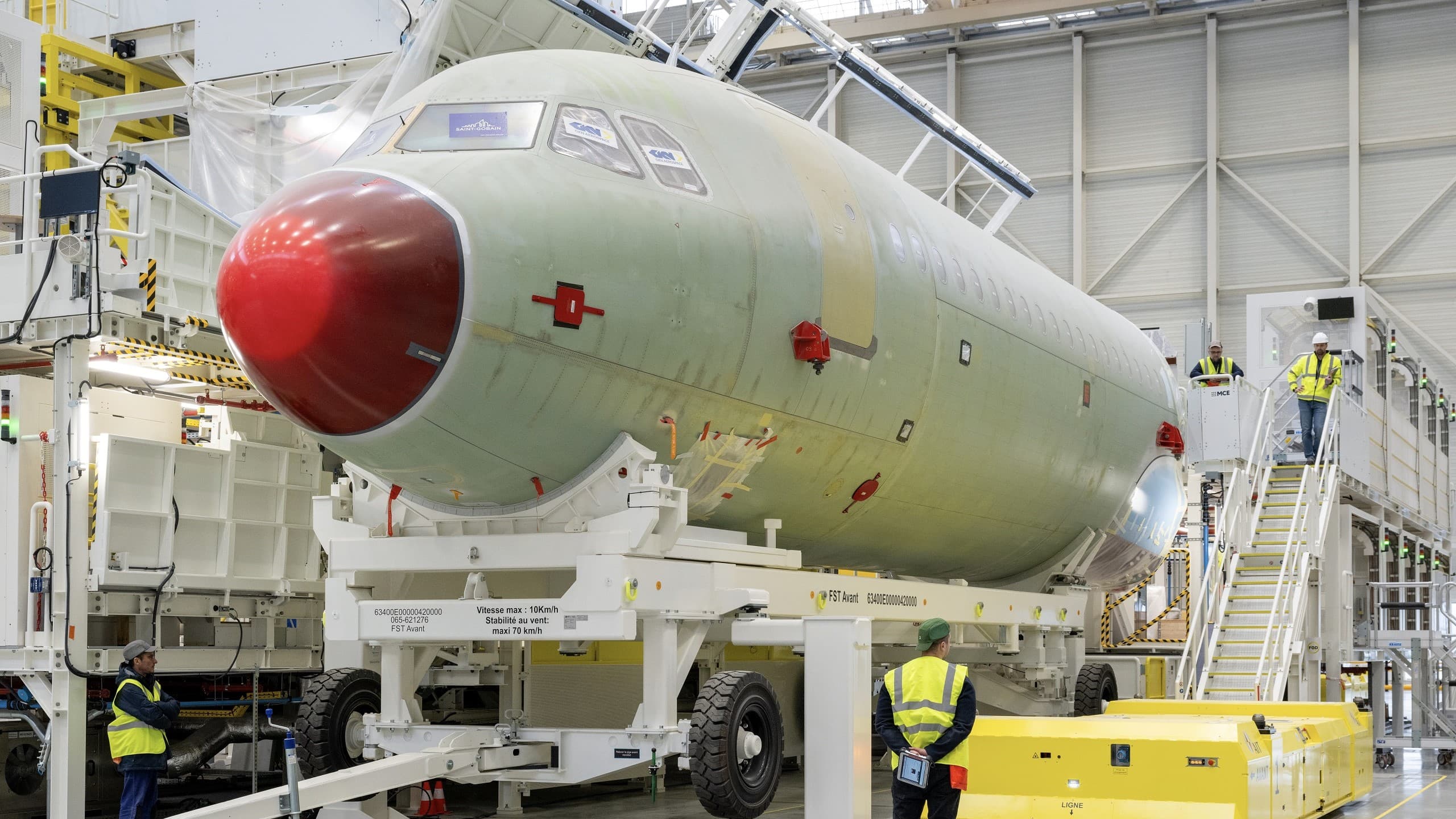
The manufacturer attributes part of the weaker start to persistent supply chain constraints, particularly Pratt & Whitney engines for some A320neo family aircraft. CEO Guillaume Faury noted that "the operational environment remains dynamic and complex." Despite these difficulties, Airbus maintains its industrial ramp-up targets: the A320 family aims for 70-75 aircraft per month by 2027, the A220 targets 13 per month by 2028, and the A350 aims for 12 monthly by the same date. This effort requires increased upstream production, temporarily boosting inventories and contributing to negative cash flow in Q1.
On the commercial front, demand remains very dynamic. Airbus recorded 408 gross orders and 398 net orders after cancellations in Q1, compared to 204 a year earlier. At end-March 2026, the backlog reached a record 9,037 commercial aircraft, representing over ten years of production at the targeted 2026 delivery rate of around 870 aircraft. This backlog depth confirms solid global demand for commercial aviation, driven by traffic growth, accelerated fleet renewal for more efficient aircraft, and the success of the A321neo in the medium-haul segment.
Diversification proved crucial: Airbus Defence and Space saw revenue rise 7% to €2.8 billion, with orders reaching €5 billion, up from €2.6 billion a year earlier, reflecting increased European defense needs. Airbus Helicopters recorded 79 net orders, down from 100 in 2025, but deliveries improved and revenue remained stable. These divisions provided welcome support during a quarter where commercial aviation was penalized by external constraints rather than weak demand.
Free cash flow before customer financing was –€2.5 billion in Q1, reflecting lower deliveries and inventory buildup for the ramp-up. Airbus notes that a negative first quarter cash flow is not unusual in the aerospace production cycle, as deliveries and cash receipts concentrate in the second half. The liquidity position remains comfortable, with €25.2 billion in gross cash and a net cash position of €9.8 billion at end-March 2026. This financial flexibility allows the group to fund its ramp-up, industrial investments, and R&D programs while absorbing supply chain and geopolitical uncertainties.
Despite the softer operational start, Airbus maintains its 2026 guidance: around 870 commercial aircraft deliveries, adjusted EBIT of about €7.5 billion, and free cash flow before customer financing of around €4.5 billion. Faury stated, "We are closely monitoring the potential impact of the rapidly evolving situation in the Middle East," while emphasizing that "in commercial aviation, we continue to increase our rates and produce according to our plan, navigating the Pratt engine shortage."