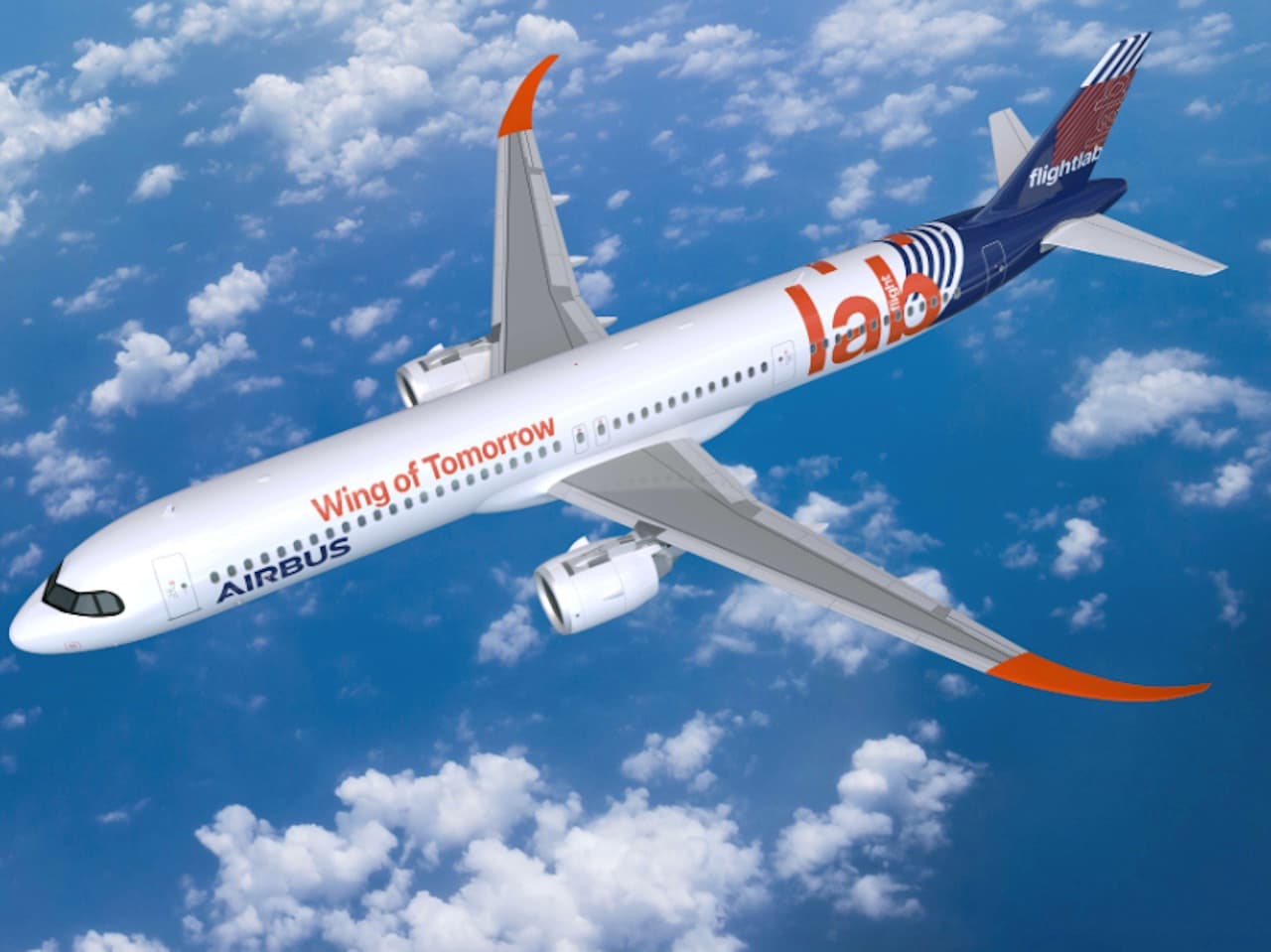
Airbus has announced a major milestone in the development of its next-generation single-aisle aircraft. At the Farnborough Airshow, the European manufacturer revealed the launch of a flight test campaign to evaluate large-span wings, a logical extension of its extensive Wing of Tomorrow research program. This program is one of the key technological pillars for the future successor to the A320 family.
**Longer, thinner, lighter, and partially folding wings**
The principle is simple in ambition but complex in execution: design full-scale wingtip extensions, install them on an A321neo, and measure in flight how increased wingspan affects flight mechanics, drag, and fuel consumption. Airbus specifies that these elements, several meters each, will replicate a folding wing in its fully deployed position during flight, equipped with comprehensive measurement gear to monitor aerodynamic and structural behavior. At the heart of Wing of Tomorrow, Airbus aims to validate a new wing architecture: longer, lighter, and more slender to optimize aerodynamic efficiency and reduce fuel burn. The stakes are high because the wing, along with the engine, remains one of the primary levers for aircraft performance in terms of range and emissions. The manufacturer indicates that final designs are still being refined through advanced digital modeling and wind tunnel tests before the flight test phase. Airbus has already built three 17-meter ground demonstrators to study the benefits of increased wingspan and test over 100 manufacturing and assembly technologies. This step illustrates the industrial logic of the program: reducing risk before freezing design choices that will shape the future single-aisle aircraft.
**Why the A321neo serves as a testbed**
The choice of the A321neo is no coincidence. This platform, already widely used by Airbus for tests and long-range variants, offers a representative base for testing aerodynamic behaviors close to those of a future next-generation airliner. In practice, the goal is to observe how a longer wing alters lift, flight loads, structural flexibility, and ground operational constraints. Airbus notes that the extensions will be assembled at the Wing Technology Development Centre in the UK and then flight-tested in Toulouse. Operationally, wingspan is a critical factor: a longer wing often improves cruise efficiency but imposes trade-offs on weight, structural strength, taxi performance, and compatibility with airport infrastructure. This is where folding devices come in, allowing a balance between in-flight performance and ground constraints.
**A program supported since 2014**
Airbus reminds that Wing of Tomorrow has received £227 million in funding from the Aerospace Technology Institute since 2014, as part of a partnership involving ATI, the Department for Business and Trade, and Innovate UK. This support reflects the strategic importance of aerospace research in the UK, where a significant portion of Airbus's wing expertise remains based. The stakes go beyond the demonstrator itself. Airbus explains it aims not only to improve aerodynamic performance but also to develop new industrial processes capable of increasing production rates and reducing costs. In an industry where ramp-up timelines have become a major issue, the promise of a more efficient wing must also come with better industrialization.
**Parallel progress on the eXtra Performance Wing demonstrator**
Alongside Wing of Tomorrow, Airbus UpNext is accelerating its eXtra Performance Wing demonstrator, focused on a wing that can change shape in flight to maximize aerodynamic efficiency. According to Airbus, assembly of this demonstrator is nearly complete in Cazaux, southwestern France, with a first remotely piloted flight expected by the end of 2026. This program explores a complementary path: instead of just lengthening the wing, it aims to vary its behavior depending on flight phase, turbulence, or instantaneous loads. FlightGlobal describes this demonstrator as based on a modified Cessna Citation VII, equipped with folding wingtips and automatic load alleviation systems, with flight tests scheduled from 2026. This approach confirms Airbus's intent to multiply experimental architectures before deciding on the next-generation single-aisle design.
**A significant step toward the A320 successor**
Airbus is not yet revealing everything about the future A320 replacement, but the direction is clear: lower fuel consumption, increased wingspan, improved aerodynamic performance, and adapted production processes. The tests announced at Farnborough are therefore more than a technical milestone—they are an industrial signal. They show that the manufacturer is entering a phase where flight demonstration becomes essential to validate what has so far been mostly simulation and ground testing.