**Airbus Sees Global Air Traffic Doubling by 2045, Driven by Urbanization and Middle Classes**
On July 8, Airbus released its Global Market Forecast (GMF) 2026‑2045, projecting that global passenger traffic will grow at an average annual rate of 3.9%, reaching nearly 10 billion passengers by 2045. The European manufacturer identifies urbanization, GDP growth, and the expansion of middle classes as the primary drivers of this demand. This forecast is particularly relevant for ATPL and ATC students, as it outlines the future shape of the aviation industry they will work in.
**Key Drivers: Urbanization and New City Pairs**
Airbus notes that urbanization is no longer limited to major metropolises but is spreading to medium-sized cities with rapidly growing populations and purchasing power. Combined with rising middle classes and diasporas, this trend will create new city pairs made economically viable by more efficient aircraft and higher passenger volumes. The GMF describes a gradual decentralization of air networks beyond traditional hub-and-spoke systems, with direct connections between medium-sized cities emerging. Examples include routes like Riga–Tenerife and Melbourne–Alice Springs, already profitably served by the A220. The extended range of single-aisle aircraft also enables new transcontinental links such as Lisbon–Recife and Dublin–Nashville on the A321neo or A321XLR, Algiers–Kuala Lumpur on the A330neo, and Taipei–Phoenix on the A350.
**Product Strategy and Fleet Needs**
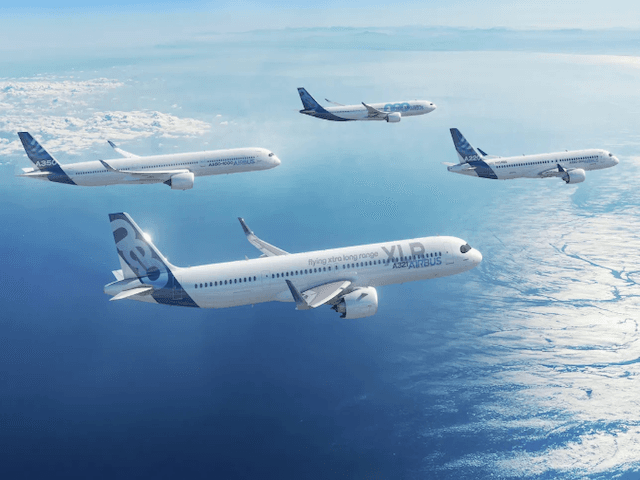
Airbus states that its product strategy directly reflects these trends, with a record order book of around 9,000 aircraft, from the A220 to the A350. This portfolio supports high production rates, including a target of 75 A320-family aircraft per month. Notably, over 70% of A320-family orders are for the largest variant, the A321neo and its long-range A321XLR, seen as ideal for opening new city pairs. High-capacity routes remain served by the A330neo, while ultra-long-haul is addressed by the A350, whose cargo variant is also successful. Over the 2026‑2045 period, Airbus estimates a need for 42,060 new aircraft, including 19,820 replacements and 22,240 net additions for growth. Of these, 81% will be single-aisle, confirming the long-term trend toward more compact, fuel-efficient, and versatile aircraft.
**Regional Shift and VFR Traffic**
The forecast highlights a shift in economic power toward the Asia-Pacific region, with particularly strong growth expected in India, Vietnam, Indonesia, and Malaysia. These markets will play a central role in traffic dynamics, especially in high-density domestic and regional segments. Airbus also notes an increase in international travel linked to migration and family visits, the VFR (visiting friends and relatives) segment. The structuring of transnational diasporas, combined with more direct connections, should strengthen these flows, especially between emerging economies and countries with high immigration in Europe, North America, and the Middle East.
**Resilient Growth Despite Short-Term Shocks**
Despite short-term disruptions such as regional conflicts, fuel price volatility, or economic cycles, Airbus believes passenger traffic growth remains robust and closely correlated with global economic expansion. The GMF projects a 3.9% annual traffic increase, supported by 2.6% global GDP growth, an additional 1.3 billion urban residents, and 1.4 billion more people joining the middle class by 2045. The middle-class demographic, most likely to fly, is expected to grow by 34% over the period, sustaining demand despite occasional shocks. By 2045, air traffic will more than double to about 10 billion passengers annually, consistent with previous GMF projections that already indicated a doubling of the global fleet in twenty years.