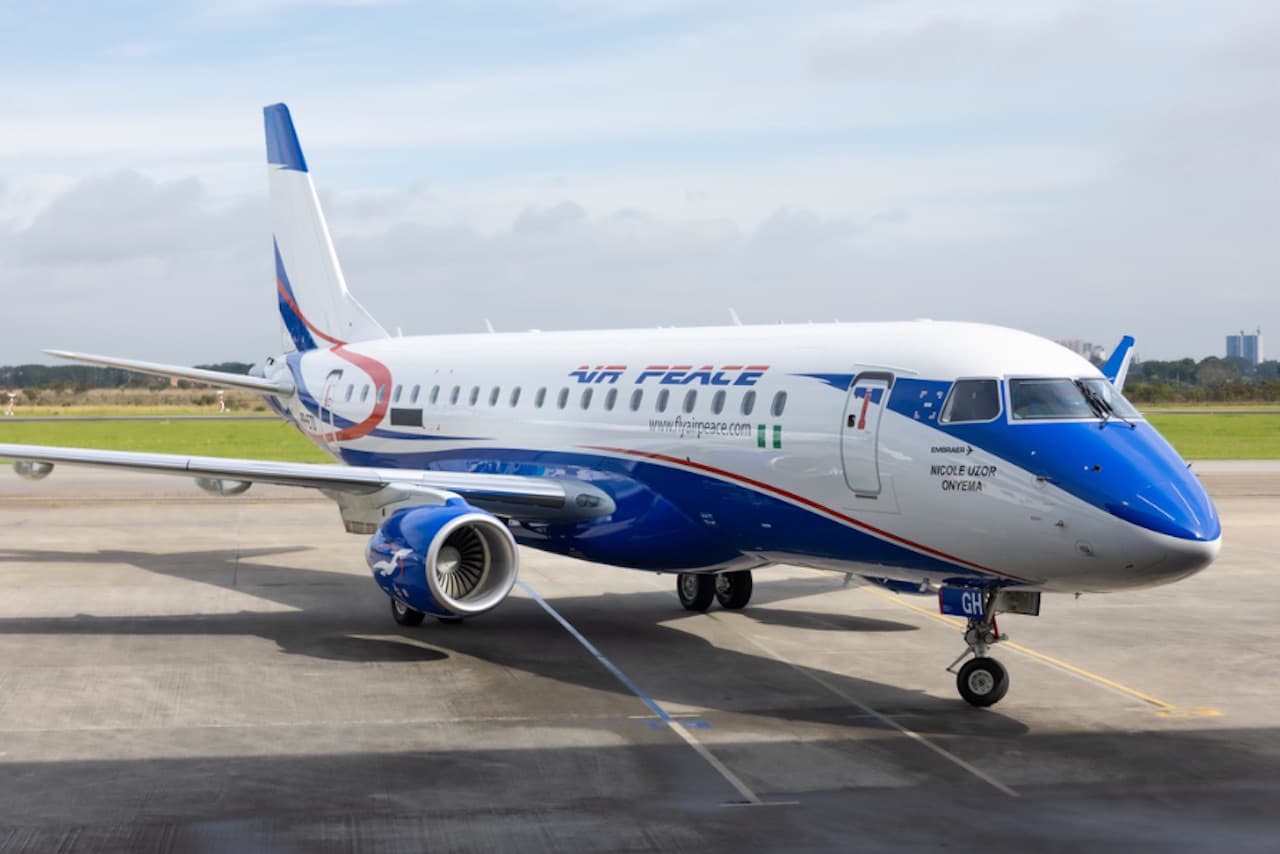
**Air Peace Takes Delivery of First Embraer E175 to Boost West African Network**
Nigerian carrier Air Peace has taken delivery of its first Embraer E175, a regional jet that will support the expansion of its network across West and Central Africa. This introduction marks a new step in the ramp-up strategy of West Africa's largest airline.
**A new asset in an already diverse fleet**
Embraer announced on June 30, 2026, the delivery of the first new E175 to Air Peace. The aircraft joins a heterogeneous fleet that already includes Boeing 777s (5 units) for long-haul, Boeing 737s for medium-haul, as well as 5 Embraer E195-E2s (8 more to come) and ERJ145s (8 units) for regional operations. With the E175, Air Peace introduces an intermediate link particularly suited to low- or medium-density routes.
The Brazilian manufacturer highlights the aircraft's economic performance, with reduced fuel consumption and lower emissions, as well as operational flexibility that allows airlines to open or test new routes without excessive financial exposure. "This delivery illustrates the sustained demand for aircraft with the right capacity, enabling airlines to expand their network while maintaining a high level of efficiency and service," said Arjan Meijer, President of Embraer Commercial Aviation.
**A targeted expansion strategy**
For Air Peace, the arrival of the E175 is part of a progressive and controlled expansion logic. The airline plans to increase frequencies on certain domestic Nigerian routes and launch services to at least four new African cities. "As we consolidate our leadership position in West and Central Africa, this aircraft will increase our operational flexibility and commercial reach, while maintaining the safety and service standards expected by our passengers," said Air Peace Chairman and CEO Allen Onyema.
Founded in 2014, the airline has established itself as a major player in African air transport, with a strategy combining a dense domestic network and growing international ambitions. It notably operates flights to London and has recently developed links to the Caribbean (Antigua, Barbados), while obtaining authorizations to serve Brazil.
**A still under-connected African market**
The arrival of new regional aircraft comes in a context of persistent under-connectivity on the continent. According to Embraer's 2026 "Africa Connectivity" report, 55 intra-African city pairs remain without direct service, up from 45 in 2025. This fragmentation of the African air network, often linked to economic, regulatory, and infrastructure constraints, opens a strategic space for intermediate-capacity regional aircraft. The E175, with approximately 70 to 88 seats depending on configuration, is positioned precisely in this segment.
**What this means for ATPL and ATC students**
For ATPL students, this case study illustrates how fleet planning decisions—choosing the right aircraft type for a specific market—directly impact route profitability and network growth. For ATC students, the introduction of a new aircraft type into a region with fragmented airspace and varying ATC capabilities highlights the importance of understanding aircraft performance characteristics (speed, altitude, range) to manage traffic flows efficiently. The E175's ability to serve thinner routes also means ATCs may see increased traffic at secondary airports, requiring adapted procedures and coordination.