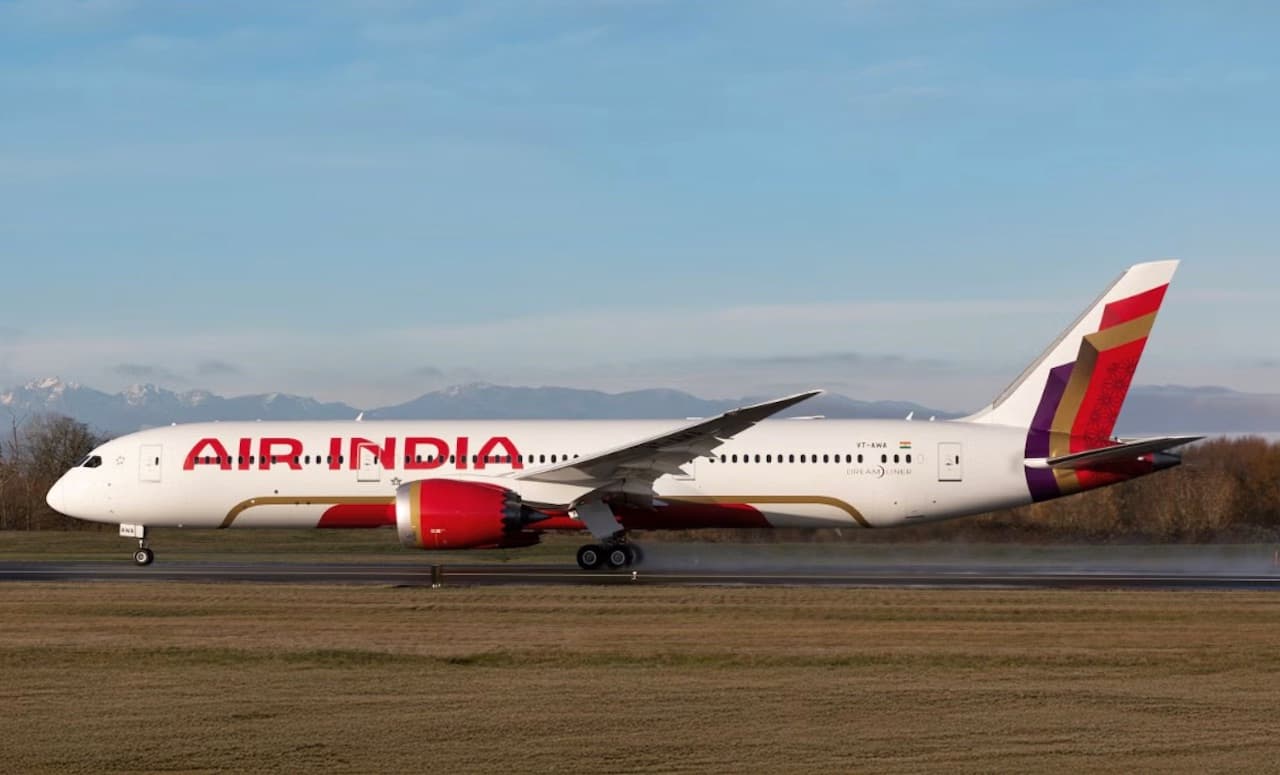
Air India is facing a significant shift in its growth strategy as it negotiates the postponement of aircraft deliveries and reduces its flight schedule. This decision comes in the wake of record financial losses and a damaged reputation following a tragic crash in June 2025. The airline, which was taken over by Tata Group in 2022, has been directed to temper its expansion plans to focus on stabilizing operations and cutting costs. Since 2022, Air India has accumulated losses exceeding 550 billion rupees (approximately 5.8 billion dollars), with an annual deficit estimated at nearly 3 billion dollars, marking the highest in its history.
Several factors have contributed to this financial turmoil, including the fatal crash of a Boeing 787 Dreamliner, the closure of Pakistani airspace, the ongoing conflict in Iran leading to costly detours, soaring fuel prices, and the depreciation of the rupee against the dollar. These challenges have forced Air India to reassess its ambitious expansion plans, which were initially based on strong growth in Indian air traffic and substantial aircraft orders. The airline is currently in discussions with Airbus and Boeing to delay the delivery of up to 500 aircraft already ordered, which would postpone significant payments due upon delivery, potentially amounting to 80% of the purchase price.
In 2023, Air India placed a record order for 470 aircraft, with an additional 100 Airbus planes ordered in 2024, and is still negotiating for 80 to 100 wide-body aircraft and 200 single-aisle jets. Concurrently, the management is reevaluating plans for new domestic and international routes, postponing certain launches, including those from the new international airport in Noida near New Delhi. The airline has already announced reductions in international capacity in response to the conflict in Iran and airspace closures, focusing on operational stability rather than unchecked growth.
Air India currently serves 60 domestic and 51 international destinations, but its international routes are under pressure from geopolitical tensions and high jet fuel prices in the domestic market. These constraints have led to cuts in flight frequencies on certain routes and temporary adjustments to long-haul schedules, officially to ensure operational reliability and minimize last-minute cancellations. The current fleet, consisting of 184 single-aisle and wide-body Airbus (A320 and A350) and Boeing (777 and 787 Dreamliner) aircraft, must be managed carefully during this transition and cabin renovation period.
Following Tata's acquisition of Air India, a comprehensive transformation plan was launched, including a new logo and branding unveiled in mid-2023, accompanied by a $400 million cabin modernization program. Most Airbus A320neo aircraft have already been reconfigured, and upgrades are ongoing for the Boeing 777 and 787 models. However, this ambitious modernization effort is being hindered by supply chain delays that are pushing back both renovations and some aircraft deliveries, thereby delaying product improvements and network expansion ambitions. The decision to defer new deliveries while continuing internal renovations reflects a short-term priority on product quality and financial balance over rapid fleet expansion.
Air India, founded in 1932 by entrepreneur JRD Tata, became a national airline after being nationalized in 1953. Decades of public management have been marked by intense competition, political decisions, and poor management, leading to a massive debt burden and a lasting brand decline. In 2022, Tata Group acquired the airline for $2.2 billion, aiming to revive it with the support of a strategic investor, Singapore Airlines, which now holds a 25.1% stake. Despite the ongoing turnaround efforts, the Indian flagship carrier remains under scrutiny following the June 12, 2025 crash, the worst aviation disaster in a decade, with the final investigation report still pending. Governance issues have also arisen, with CEO Campbell Wilson announcing his resignation in April, remaining in position until a successor is appointed. Reports suggest that candidates for the role include Nipun Aggarwal, Air India's commercial director, and Vinod Kannan, an executive at Singapore Airlines. This governance change occurs amid a strategic refocus, as Tata Trusts, which oversees Tata Sons, expresses concerns over the level of losses and pushes for a balance between expansion and financial discipline. In this context, Air India must demonstrate its ability to continue its transformation, enhance its product offerings, and maintain its status as a major player in Indian aviation while scaling back in the short term.