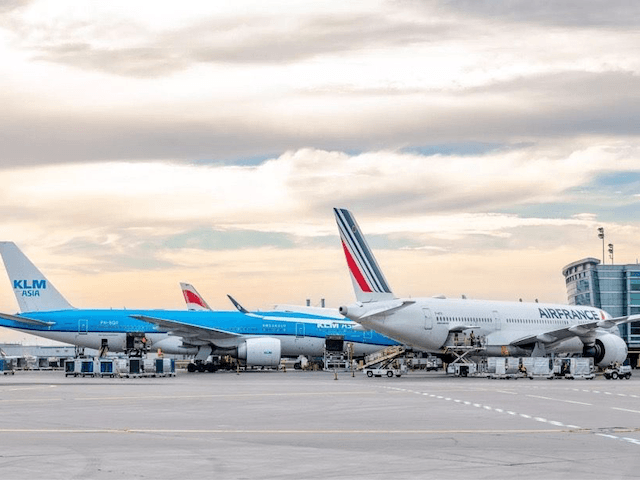
**Air France-KLM is preparing to rename its holding company, but the group remains tight-lipped about the future name as the Franco-Dutch airline group accelerates its European consolidation strategy.** CEO Benjamin Smith is deliberately keeping the mystery alive while confirming that a rebranding is indeed in the works.
The name change does not affect the airlines themselves—Air France, KLM, Transavia, and soon SAS will keep their commercial brands. The rebranding targets only the holding company, aiming to adapt the group's identity to a broader scope. Smith used the Paris Air Forum to confirm that discussions on the future name are well underway, mixing humor and discretion. "We joke all the time within Air France-KLM about the few potential names we could have," he said yesterday. When asked about the rumored name "The Blue Group," which several media outlets had reported, Smith shut it down: "That's not true." He made it clear that the group is not trying to promote this new brand to the general public.
The rebranding is expected to be nearly invisible to consumers, with the group's airline brands—Air France, KLM, Transavia, and soon SAS—remaining unchanged. "We try to keep the brand away from consumers as much as possible, so that consumers focus on the brands of each airline, KLM, Air France, Transavia, and soon SAS," Smith explained. The new name is therefore aimed primarily at financial markets, institutional partners, and the industrial ecosystem.
**A holding company built for European consolidation**
This name change comes as Air France-KLM prepares to integrate Scandinavian airline SAS, in which it will take a 60.5% stake by 2026, pending regulatory approval. The Franco-Dutch group already holds 19.9% of the Nordic carrier and sees this operation as a major lever for strengthening its position in Northern Europe. At the same time, Air France-KLM is a candidate to acquire a stake in Portuguese airline TAP Air Portugal, which is being privatized, to secure a strong position on one of the two major hubs on the Iberian Peninsula. "There are three European groups and two hubs on the Iberian Peninsula. One of them will end up without a partner. So for us it's very important," Smith emphasized, referring to Lisbon and Madrid.
Air France-KLM is thus adopting the model of the Anglo-Spanish group IAG, which controls British Airways, Iberia, Aer Lingus, and Vueling, rather than remaining confined to the Air France and KLM brands alone. In contrast, the Lufthansa Group retains the name of its parent company while operating subsidiaries Austrian Airlines, Brussels Airlines, ITA Airways, SWISS, and Eurowings.
**What this means for ATPL and ATC students:** Understanding the strategic moves of major airline groups like Air France-KLM is crucial for future pilots and controllers. Consolidation affects network planning, hub operations, and career opportunities. Knowing how holding structures work—and how they differ from IAG or Lufthansa—helps you grasp the competitive dynamics that shape your future workplace.