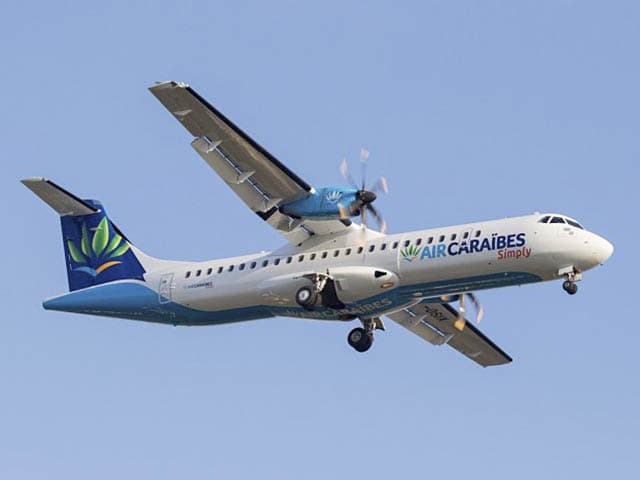
**Air Caraïbes has announced a new seasonal nonstop service between Fort-de-France (FDF) and Saint-Martin Grand Case (SFG), operated twice weekly from July 3 to August 30, 2026, using an ATR 72-600.** This direct link bypasses the traditional hub at Pointe-à-Pitre, reducing travel time to 1 hour 25 minutes and eliminating the need for a connection. The airline is offering an introductory round-trip fare from €249, positioning the route as both a convenience for travelers and a test of point-to-point viability in the Caribbean market.
**For ATPL and ATC students, this development is a practical illustration of several key aviation concepts.** First, the choice of the ATR 72-600—a twin-engine turboprop optimized for short-haul, high-frequency operations—demonstrates fleet planning tailored to regional demand. Second, the seasonal nature of the service (18 rotations over two months) reflects yield management and capacity adjustment strategies, where airlines match supply to peak travel periods. Third, the route complements existing services via Pointe-à-Pitre, creating a network that balances hub-and-spoke with direct connections, a classic trade-off in airline network design.
**The broader context includes the recent reorganization of Air Antilles and increased government focus on territorial continuity in the French Caribbean.** Air Caraïbes is also adjusting schedules at Pointe-à-Pitre to improve connections, and has launched a Paris-Orly to Saint-Martin Juliana (SXM) route using an A330-200. These moves highlight the importance of integrated scheduling and inter-hub coordination, topics directly relevant to ATC students studying airspace management and slot coordination, as well as to ATPL candidates learning about airline operations and route profitability.
**From an operational standpoint, the new route avoids a stopover at Pointe-à-Pitre, reducing total journey time and complexity for passengers—especially those unfamiliar with multi-segment itineraries.** This is a classic example of how airlines can capture VFR (visiting friends and relatives) and intra-Caribbean tourism traffic by offering simpler itineraries. For ATC students, the introduction of a new city pair may require adjustments to airspace flow management, especially during peak summer months when convective weather is common in the region.
**In summary, Air Caraïbes' seasonal Fort-de-France–Saint-Martin service is more than a routine route addition—it is a case study in regional airline strategy, fleet utilization, and network optimization.** For aviation trainees, analyzing such developments helps build a deeper understanding of the commercial and operational forces that shape real-world air transport.