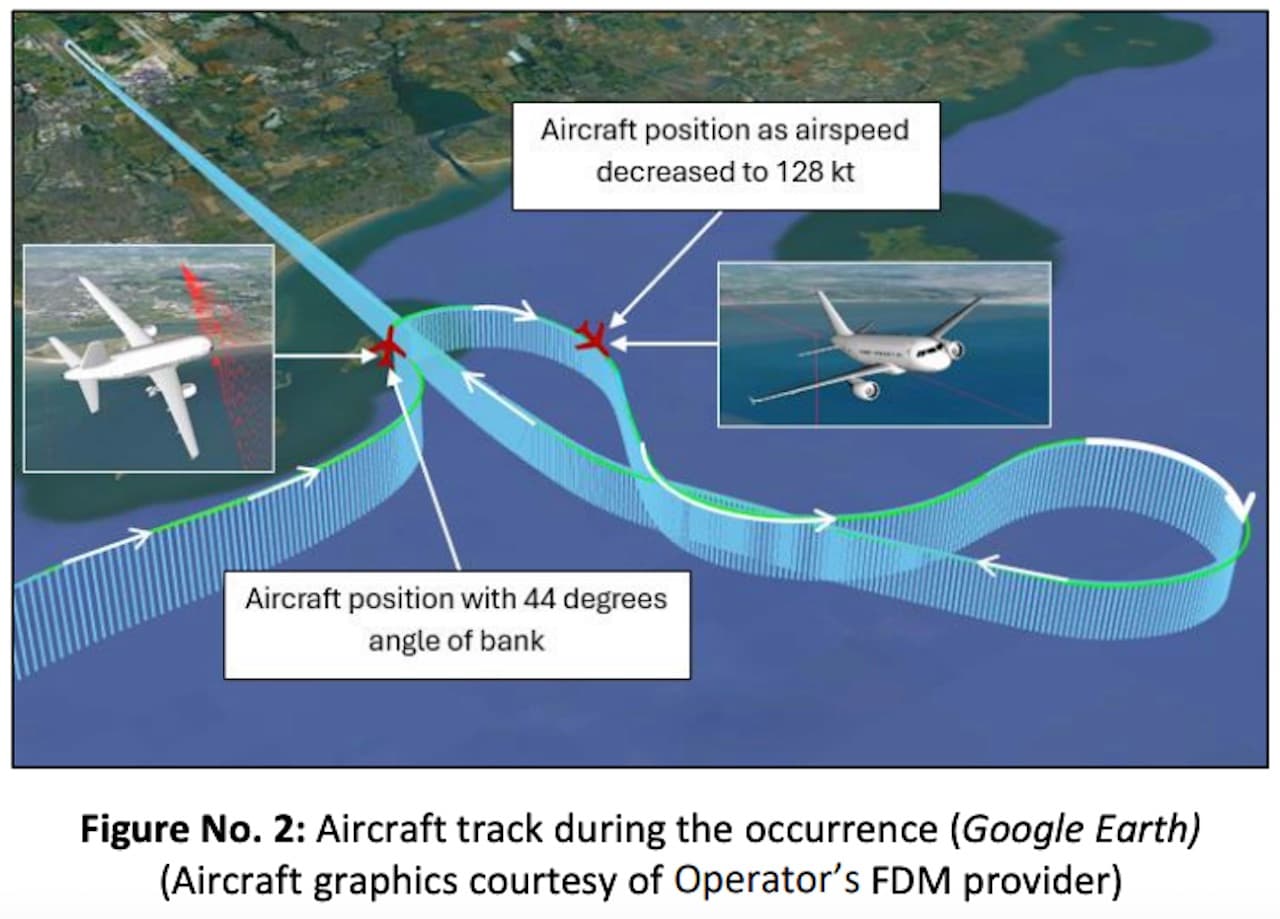
On January 14, 2025, an Aer Lingus Airbus A320-214, registration EI-DEE, operating flight EI493 from Faro to Dublin with 140 passengers and six crew, experienced a destabilized approach and a subsequent go-around that involved a 44-degree bank angle, exceeding the typical operational limit of 33 degrees for such maneuvers. The final report by the Irish Air Accident Investigation Unit (AAIU), published on July 31, details how the aircraft arrived too high and too fast on approach to runway 28L, prompting the captain to disconnect the autopilot and deploy full spoilers to expedite the descent. This manual intervention, combined with the high workload of an unstable approach, degraded the captain's situational awareness, leading to a deviation south of the cleared flight path and an involuntary excursion from the aircraft's normal flight envelope.
During the go-around, the A320 twice dropped below VLS, the minimum selectable speed protected by Airbus automation to maintain a margin above stall. The low-speed protections activated, and the aircraft climbed to 4,200 feet despite a clearance to maintain 3,500 feet. Despite these challenges, the crew regained control, re-approached, and landed safely about ten minutes later, with no injuries or damage reported. The captain told investigators he had not slept well the night before his last duty day and acknowledged he 'may have been fatigued.' However, the operator's fatigue risk assessment placed his schedule within acceptable limits, so fatigue was not deemed the sole cause. Instead, the AAIU emphasized that the combination of manual flying and the pressure to recover a degraded approach led to reduced situational awareness.
This incident underscores a critical lesson for aviation professionals: the standard operating procedure is to execute a go-around when an approach is not stabilized, rather than attempting to salvage it. The go-around is a normal, safe decision, not a failure. The report also highlights a significant reporting delay: the event occurred on January 14, but was not reported to authorities until March 18, approximately two months later, far exceeding the European requirement of 72 hours for such occurrences. This delay meant that the cockpit voice recorder (CVR) and flight data recorder (FDR) data were no longer available, forcing investigators to rely on operational data, witness statements, and operator-provided information.
For ATPL and ATC students, this case is a powerful study in threat and error management, the importance of stabilized approach criteria, and the human factors that can compromise situational awareness. It also illustrates the critical role of timely incident reporting in enabling thorough safety investigations. Understanding these elements is essential for future pilots and controllers to prevent similar occurrences and to foster a robust safety culture.