British Airways 777 descends rapidly after Irish Sea depressurisation
En route to Chicago, a British Airways Boeing 777-200ER suffered a cabin depressurisation at 36,000 ft, triggering emergency procedures and an overweight return to London Heathrow.
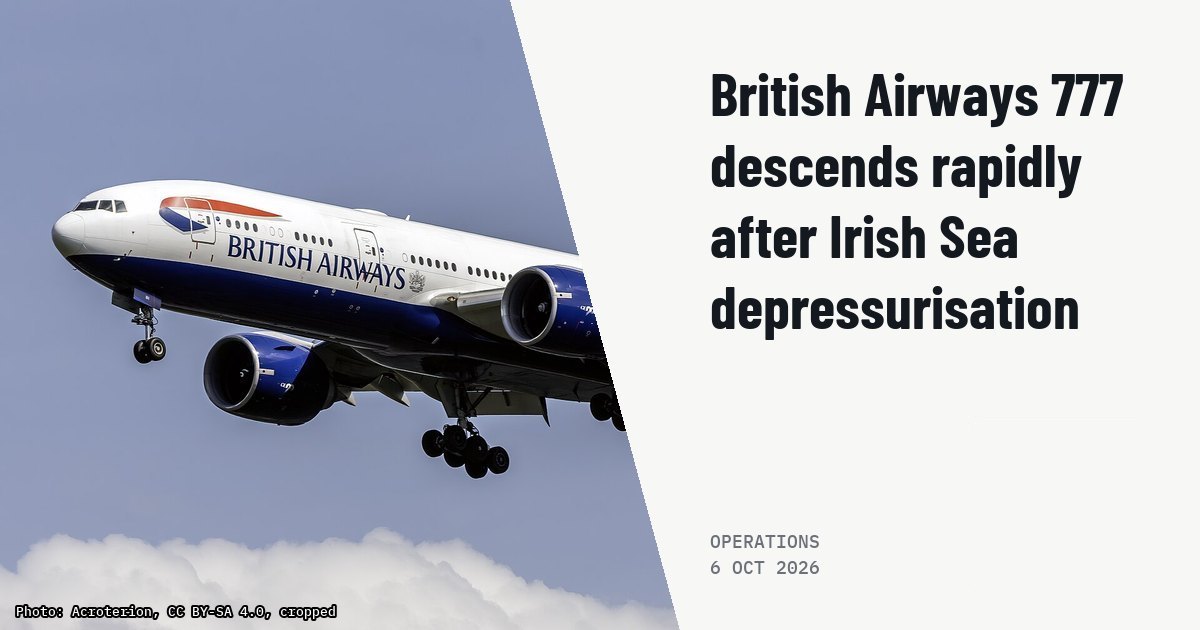
On 5 October 2026, British Airways flight BA295 departed London Heathrow bound for Chicago O’Hare. Approximately one hour into the flight, while cruising at 36,000 ft about 40 NM south of Dublin over the Irish Sea, the Boeing 777-200ER experienced a sudden loss of cabin pressure. Cabin altitude climbed past 10,500 ft, which automatically released the passenger oxygen masks.
The flight crew transmitted emergency squawk 7700 to alert air traffic control and obtain navigation priority before initiating a standard emergency descent. Descending at an average rate of approximately 3,800 ft/min, the twinjet descended roughly 27,000 ft over a seven-minute period, leveling off at 9,000 ft where supplemental oxygen is no longer required.
Flight continuation across the Atlantic was ruled out due to heightened fuel burn at lower flight levels. Because departure fuel placed the aircraft well above its maximum landing weight, the crew flew holding patterns over southwest England, the Bristol Channel, and the English Channel to burn off fuel. Registered G-VIIA, the aircraft landed safely back at Heathrow in the late afternoon, where airport fire services stood by without intervening. Ground staff assisted passengers during normal disembarkation. Maintenance teams are now inspecting the outflow valves, door seals, and air conditioning pack systems to establish the root cause.
Why it matters for your training
This event demonstrates the operational application of emergency descent profiles and fuel-burn holding strategies when facing a rapid depressurisation well above maximum landing weight.
Sources
Article rewritten with the help of AI from the cited sources.